What event planners and experience designers need to know
- Reframe corporate event strategy to design for momentum rather than moments.
- Identify key business outcomes and what attendee behaviors will influence event ROI.
- Create intentional pathways that connect attendee success to business impact.
If you’re not designing what happens before and after the live event experience, much of the intended impact will fade before business outcomes can take hold. Organizations generating the strongest event ROI treat events as part of their ongoing engagement strategy, not isolated moments on the calendar.
Related: Not sure what to measure? Check out these 8 metrics to prove ROI.
As corporate event strategists, we design ideal experiences for attendees to connect face-to-face and absorb high-quality content. For a long time, event teams measured our success in attendee satisfaction scores shared immediately after an event. Quite frankly, we were going on “vibes.”
The problem: Vibes-based feedback doesn’t prove your event advanced business goals or that attendees learned or changed their behavior. And expecting to see those results so soon is unrealistic.
Introducing our corporate event design framework at CEMA Summit
Since introducing ITA Group’s Events 365 framework for creating, sustaining and measuring event impact, our team has been advocating for an industry-wide shift in how corporate event strategists achieve success.
My colleague, ITA Group Event Analytics Advisor Anna Boggs, and I co-presented a CEMA Summit workshop, “Sticky strategy: Your event isn’t the end. It’s the beginning,” to share what we’ve discovered with event industry leaders and innovators.
Building on our 2025 CEMA Summit breakout, we explored how working from neuroplasticity principles helps event planners combat the natural “forgetting curve” and strengthen the event lifecycle. Our session attracted attendees eager to rethink event strategy. Here’s a peek into the hands-on workshop we led.
Designing corporate events for business impact
As event strategists, our job is to make the attendee experience more relevant and exciting. Our responsibility is also to make the desired outcome(s) more likely by designing an event ecosystem that works toward achieving them.
We gave our CEMA workshop participants various event scenarios and asked them to spot where momentum is strong, where it breaks down, and where they'd invest time, attention, and budget to create stronger sustained impact across five phases:
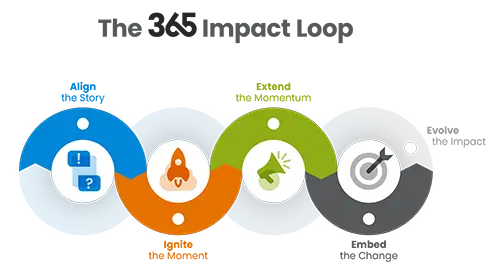
- Align: Connect business strategy with behavioral science to create active participants
- Ignite: Deliver a peak experience that sparks belief, energy and alignment
- Extend: Grow the event's impact with post-event communications
- Embed: Release microlearnings to reinforce event takeaways
- Evolve: Compare post-event results with pre-event baselines to make adjustments for next year
Think about your next corporate event and consider how you’re caring for each phase of the loop. We’ve seen organizations often overinvest in the Ignite (live event) phase because it’s the most visible part of the work. But if managers don’t reinforce messaging afterward and people don’t repeat the behavior, we’re creating a short-term spike.
Related: Learn how the five elements within the Events 365 event lifecycle framework loop for stronger impact.
Even if we’d like to imagine our events as beautiful islands of attendee engagement and inspiration, no employee summit, user conference, sales kickoff or trade show is a truly isolated experience.
Attendees Event experiences are sandwiched between work and home demands. Their fractured attention, paired with natural knowledge attrition, means many event takeaways fade fast. | Planners The event is an important moment for establishing credibility and trust, but it becomes part of a broader learning journey. You must identify and implement continuous learning opportunities to demonstrate more impact from your event investment. |
Plan continuous learning opportunities
If we want stronger event ROI, we have to stop designing for moments and start developing continuous learning opportunities that encourage momentum toward achieving bigger goals like increased sales, deepening product knowledge and more. Weave event takeaways into attendees' day-to-day work by:
- Introducing microlearning
- Sending nudges that prompt action
- Sharing emotionally engaging content
- Promoting manager support
Shifting the focus from planning a singular event to considering the event lifecycle or “ecosystem” challenges planners to evolve, adapt and build resilience in the face of disruptions. Keep attendees at the center of decision-making.
Ask
- What attendee behavior are we trying to influence?
- Where are we relying too heavily on the live event itself?
- What would make the next action easier, more social or more repeatable?
Bridge business and attendee needs in event design
In strategic event design, we have to care for people and perform for the business. That means thinking beyond the agenda and understanding what attitudes and mindsets attendees are carrying into the room—their fatigue, skepticism, excitement, motivation or desire for connection.
Event strategy
Cultural ethos is how people are showing up right now. Overloaded, distracted, craving connection, and trying to find meaning in a noisy environment. | Business environment is how organizations are operating. Under pressure to prove ROI, move faster, more efficiently, support sellers, partners and customers better, and create experiences that actually change outcomes. |
Ask
- Why is the event being held?
- What determines success?
- What does the organization need employees, sellers or partners to do or know after attending?
Infuse events with empathy
The best events advance business objectives and create intentional pathways for attendees to achieve their individual goals. Well-defined attendee personas should articulate what motivates that segment.
Ask
- What is your primary attendee audience challenged by at the moment? What’s energizing?
- What event components will they be excited about? Skeptical of?
- How can you help them find meaningful connection?
- Where can you build reciprocity into the journey?
Related: These four science-based corporate event strategies boost attendee learning.
Expect disruptions to challenge the event ecosystem
Internal and external disruptors impact planning, operation and post-event phases. (Think: A leader suggesting last-minute additions to the event agenda or breaking news gluing everyone to their screens right before your keynote speaker is about to take the stage.)
We challenged workshop attendees to respond to similar situations as part of our exercise by pulling “disruptor” cards. (Your measurement plan connects to business outcomes. Collect 2 tokens!). How can you prep for disruptions?
Ask
- Where might forces work against or accelerate your goals in the learning and planning journeys?
- How can you proactively plan for them?
Shifting event design for the future
The most effective event leaders aren’t asking, “Did attendees enjoy the event?” They’re asking, “What happened because of the event?” That shift changes how we design experiences, allocate budgets, measure success and support attendees long after the closing sessions.
Incorporating Events 365 could strengthen your corporate event strategy. Get the complete framework in our recent Skift report.